Multiple TIFF Frames
Read supported frames from one TIFF container and place them into PDF pages. The job accepts up to 40 image frames.

Convert supported TIFF frames into PDF pages on your device.
Drop files here or use the button below.
Up to 100 MB total · Files stay on your device
Preview the document here. For added content, this is a placement guide; check the saved output.
Convert a TIFF image into a PDF using the TIFF decoder running in your browser. TIFF containers can hold several frames, which are useful for scanned archives and fax-style document sets. Supported frames are written as PDF pages.
The decoder reads supported TIFF frames and embeds them as lossless PNG images in the PDF. Color handling and support for unusual TIFF variants depend on the encoding; camera RAW data and specialized scientific channels are not promised. The input limit also applies to the number and dimensions of frames.
Read supported frames from one TIFF container and place them into PDF pages. The job accepts up to 40 image frames.
Embed decoded frames as PNG images rather than adding a lossy JPEG stage. Specialized TIFF encodings still need a compatibility check.
Choose A4, Letter, custom or image-matched pages, then adjust orientation and margins for the scan set.
Decode and assemble the document on your device, within the 24-megapixel per-frame and 80-megapixel total limits.
Select one TIFF container after confirming its expected frame count.
Select the screenshot to enlarge it.
Choose how each decoded frame fits onto the PDF page and set its margins.
Select the screenshot to enlarge it.
Download the PDF and verify that the intended scan frames and page details are present.
Select the screenshot to enlarge it.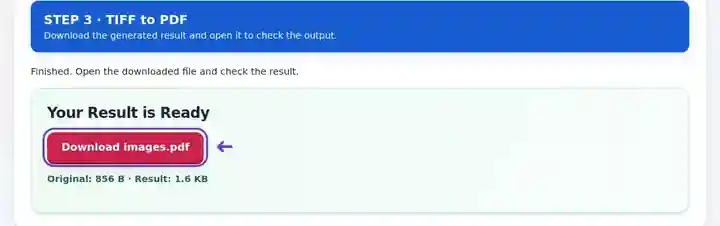
Screenshots show this toolkit using harmless sample files. Your file name, page count and settings may differ.
A scanned archive or fax-style file can hold several pages inside one TIFF. Some image viewers show only its first frame, making it easy for a reader to overlook the rest. PDF provides a familiar page sequence for review and printing. Establish the expected frame count before conversion and compare it with the downloaded page count. Preserve the TIFF when its original encoding, color profile or archival status is part of the record.
Prepare a review copy of a multi-frame scanned folder without separating frames by hand. Compare covers, blank separators and the final page with the original container.
Review a permitted legacy scanned packet in an approved document workflow. Verify that signature areas, dates and amounts remain readable; conversion is not verification of the document’s authenticity.
Share an ordinary scanned reference packet with someone who needs page navigation. Use the original record or an approved archival workflow when preservation requirements go beyond a viewing copy.
| Setting | What to expect |
|---|---|
| Accepted input | TIF, TIFF |
| Processing location | Your browser, on your device |
| File selection | One input file |
| Input size | Up to 100 MB, subject to device memory and decoded-page limits |
Each frame must stay within 24 megapixels, and the total decoded frame area must stay within 80 megapixels. The decoder is bundled with this website. A filename extension alone does not make an unsupported TIFF variant decodable.
Frame order comes from the TIFF container; there is no per-frame selection before conversion. Once the complete PDF has been checked, use Organize PDF or Delete PDF Pages to move or remove a separator.
| Situation | What to do |
|---|---|
| Only one image appears in your source viewer | Use a viewer that supports multi-frame TIFF to establish the expected count. |
| The format cannot be decoded | Export a standard TIFF or PNG copy using the scanner’s software. |
| You need search and copying | Run OCR on the PDF after conversion, if enabled, and verify the recognition. |
Consider a supported five-frame TIFF containing a cover, two scanned pages, a blank separator and an appendix. Check for that same five-page sequence in the PDF, including the blank fourth page. Remove the separator only after confirming that no content page was lost.
The processor writes the supported frames it reads. Verify the page count of a multi-frame source.
This TIFF conversion runs on your device. The document-processing code does not upload your TIFF to a conversion server.
This is a format converter, not a TIFF repair engine. Try exporting a readable copy from the application that created it.
Continue with Image to PDF, PDF to TIFF, Scan to PDF.