Well-Formedness Check
Check that the XML can be parsed before generating the listing. This is a syntax check, not schema or business-data validation.

Save XML source as readable, paginated PDF text.
Drop files here or use the button below.
Up to 100 MB total · Files stay on your device
Preview the document here. For added content, this is a placement guide; check the saved output.
Save well-formed XML source as readable PDF text. This is useful for reviewing a configuration file or sharing a source listing with a reader who does not work directly with XML.
The converter prints the XML source. It does not apply an XSLT stylesheet, interpret an invoice schema or create a formatted business document from tagged values. Malformed XML is rejected before processing.
Check that the XML can be parsed before generating the listing. This is a syntax check, not schema or business-data validation.
Keep tags, attributes and values visible as source text. The converter does not apply an invoice template or XSLT stylesheet.
Choose standard or custom paper and adjust Text size. Long source lines wrap to fit the available page width.
Write supported source characters as selectable PDF text so a reviewer can locate a tag or value in the listing.
Choose a well-formed XML source file prepared for a readable listing.
Select the screenshot to enlarge it.
Set paper dimensions and Text size to suit tag and attribute lengths.
Select the screenshot to enlarge it.
Download the PDF listing and check visible markup, line wrapping and text selection.
Select the screenshot to enlarge it.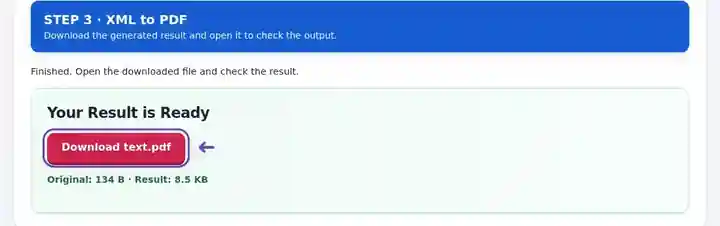
Screenshots show this toolkit using harmless sample files. Your file name, page count and settings may differ.
A PDF source listing can accompany a change request or review when the recipient needs to read tagged data but should not edit the machine-readable file. It makes the visible source convenient to paginate and annotate in a separate reader. It is not a substitute for the XML itself: wrapped values, copied text and a correct-looking page do not establish schema validity. Keep the original file as the authoritative input to the system that uses it.
Attach a harmless configuration sample to an integration review. Format the source beforehand and check long attribute values in the PDF so wrapping does not confuse the reader.
Inspect invoice-related tags during an integration issue. Use the required business application or stylesheet for a formal invoice view; this tool shows the source markup only.
Submit a tagged example alongside an explanation of its structure. Compare opening and closing tags, then retain the XML for validation exercises and further editing.
| Setting | What to expect |
|---|---|
| Accepted input | XML |
| Processing location | Your browser |
| File selection | One input file |
| Input size | 100 MB total selection limit; each source is additionally limited to one million characters |
The input must be well-formed XML and remain within the character limit shown above. Indent a review copy in an XML editor when dense source lines would be difficult to follow.
For example, <record id="00127"><status>ready</status></record> remains a visible source listing: the tag names, quoted identifier and value are printed. Indent longer XML in your editor before conversion, and check that a wrapped attribute is still unambiguous to the reader.
| Situation | What to do |
|---|---|
| Malformed XML is rejected | Check matching opening/closing tags, quoted attributes and escaped special characters. |
| The result contains raw tags | That is the intended source-listing output. It is not an invoice or report template renderer. |
| A long attribute is hard to follow | Use a larger page width or format the XML source with sensible line breaks before conversion. |
For reviewing a configuration file, format the source in your editor and convert a harmless copy. Check whether line wrapping makes a long value ambiguous. Keep the original XML alongside the PDF; the PDF should not become the authoritative machine-readable configuration.
No. It prints source markup. Schema-aware invoice rendering requires the appropriate stylesheet or invoice application.
The browser checks that the source is well-formed XML. This does not validate its business schema or confirm that its tagged values are correct.
The XML listing is written as text, so ordinary supported characters can be selected. The visible tags remain part of the source listing.
Continue with PDF to Text, Image to PDF, PDF Reader.